|

|
|
About Handbooks |
|
|
This isn’t a site about collecting handbooks, it’s more of a site about
what’s in the handbooks and how they relate to Scouting history and
Americana.
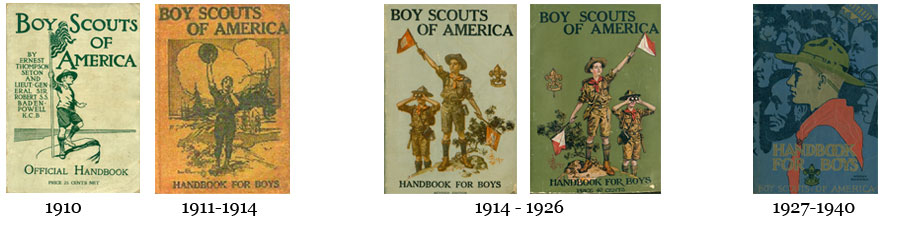
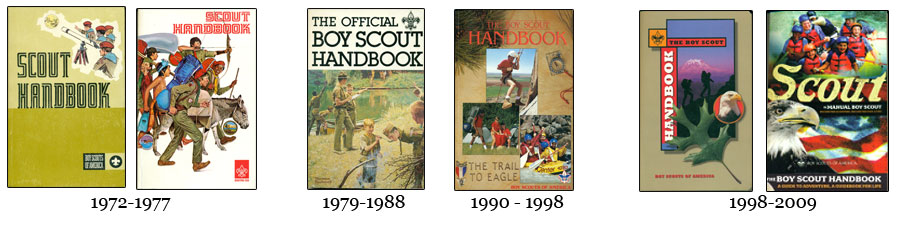
I have arranged this website by editions.
Every few years the BSA will make major revisions to the handbooks and these
come out as new editions. Sometimes the handbook identifies itself as an
edition when it’s a printing. You’ll see this in books from the 1920’s and
‘30’s. There are numerous printings of each edition. Sometimes new
information will appear and other times it’s just a matter of supplies
running low or perhaps advertising changes.
When I first started collecting, I made the incorrect assumption that each
printing had a lot of new information. If I wanted to keep up with trends, I
wanted all printings. In retrospect that was an error, although there are
cases of changes being made in printings. My interest in handbooks is what’s
inside and cover differences. Others collect handbooks more diligently, if
there are more pages, its different. If ad’s are different, they want them
all. Harris Tanner of Massachusetts was one of the earliest experts on
cataloguing handbooks in the 1960’s and 70’s. Joe Price of California took
Harris’s research to another level and published Kahuna’s Katalog in 1989.
Joe had a room in his home that was literally a library. Books stacked floor
to ceiling with a rolling ladder to access he higher shelves. Price’s book
is out of print, (to my knowledge), but some Scout “dealers” probably have
copies. It’s the “final word on handbooks. If you want more information on
all the printings try:
https://www.troop97.net/bshb1.htm This appears to be
the product of an individual affiliated with a BSA troop. I note that the
material is copyrighted, but don’t know if it’s actual original research or
if it’s material taken from other researchers. |
|
|
|
A few Collecting Tips |
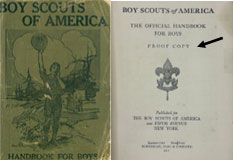
Inspect every 1911 brown cover habndbook that you encounter.
The covers on the Proof and regular editions are identical.
I have inspected dozens and never found a proof, but someone might. |
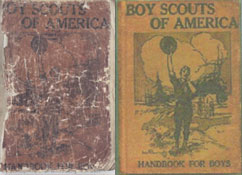
Except for the very early editions and some specialty printings this is not a
difficult collection. I’ll discuss values elsewhere.
Most books were printed in large quantities and years later they’re still
available. Hold out for books in slightly used or near mint condition. The
difference between a good and advanced collection is usually the quality
of the books in the collection. |
|
|
|
|
|
|
Paul Myers Goshen,
Indiana
gimogash@comcast.net |
|
